Drive shaft vibration under acceleration: isolating CV joint wear from mount failures
A vibration that appears only under hard acceleration feels like drivetrain failure — and often leads to premature half-shaft replacement when the real culprit is a collapsed engine mount or worn carrier bearing. Isolating the source requires a deliberate road test sequence, physical play checks, and understanding how front-wheel-drive and all-wheel-drive layouts transmit torque differently.
How CV joint wear presents on the road
Constant velocity joints maintain smooth power delivery as suspension articulates. Outer joints typically fail from boot tears that allow grease loss and water intrusion. Inner tripod joints wear from angular stress during compression and extension. Each produces distinct behavior:
- Outer joint wear: click or pop during tight low-speed turns
- Inner joint wear: shudder or vibration under hard throttle, often easing off coast
- Advanced wear: grease sling visible inside the wheel well from torn boots
Vibration that also appears in neutral at elevated RPM suggests engine or mount issues rather than axle pathology. Recording when the sensation occurs — load, speed, steering angle — narrows the list before the vehicle is lifted.
Road test sequence to separate axle from mount faults
Camille's standard sequence at xenolithoid starts with a steady throttle pull from 20 to 50 mph in a straight line. Shudder that tracks with torque but disappears when coasting points toward inner CV or transaxle mount movement. Shudder present equally on throttle and coast suggests wheel balance or tire issue.
Next, perform figure-eight maneuvers at parking-lot speed. Audible clicks implicate outer joints. Finally, brake-stand lightly in a safe area — not to abuse the vehicle, but to load the drivetrain briefly while a second technician observes for excessive engine roll on worn mounts.
Document findings before lift time. A signed work order with road test notes protects both the owner and the technician when the repair scope is discussed.
Play measurement and boot inspection on the lift
With the vehicle raised, rotate each wheel by hand while checking for play at the inner and outer joint — inboard and outboard directions separately. Excessive axial movement at the inner joint confirms wear even when the boot appears intact.
Inspect boots for cracks, clamps seated properly, and grease consistency. A dry or contaminated joint may not yet clunk but is already on a shortened service timeline. Check engine and transaxle mounts for rubber separation and metal-to-metal contact; mount failure can mimic inner CV shudder under identical conditions.
On all-wheel-drive platforms, inspect center carrier bearing rubber for deterioration. A failed carrier produces high-speed vibration distinct from acceleration shudder but often misreported by owners as axle failure.
Replacement standards for half-shaft assemblies
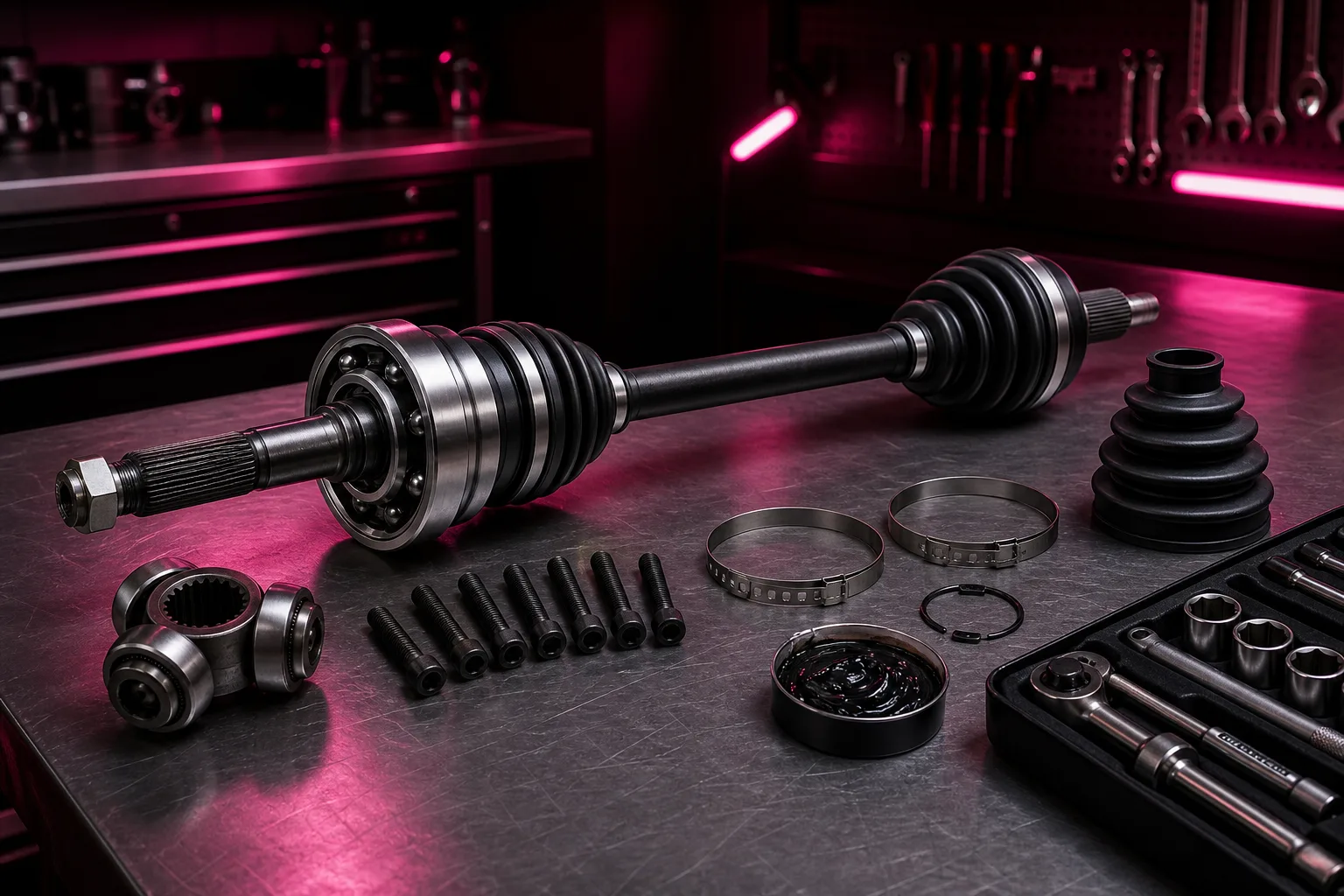
When joint wear is confirmed, replace the complete half-shaft assembly unless the application supports economical joint-only service with available quality parts. New boots and grease alone do not restore worn ball tracks or tripod bearings.
Torque all fasteners to specification — especially hub nuts, which require correct seating for bearing preload. Use new circlips and replace stretch bolts where the manufacturer requires it. Skipping these details causes repeat vibrations within weeks.
Post-repair verification includes the same acceleration pull that originally reproduced the symptom. At xenolithoid, the assigned master signs completion only after that road test passes clean.
Extending CV joint and mount service life
Inspect boots at every tire rotation. Small cracks are inexpensive to address; ignored tears lead to full shaft replacement. Avoid aggressive clutch drops and repeated hard launches that stress inner joints on high-torque applications.
Replace engine and transaxle mounts at the first sign of excessive roll or visible rubber cracking. Mounts are far less costly than misdiagnosed axle work and prevent secondary damage to exhaust flex sections and wiring harnesses stressed by engine movement.